NBA First Basket Betting: possession tipoff statistics 2026
 Available in US
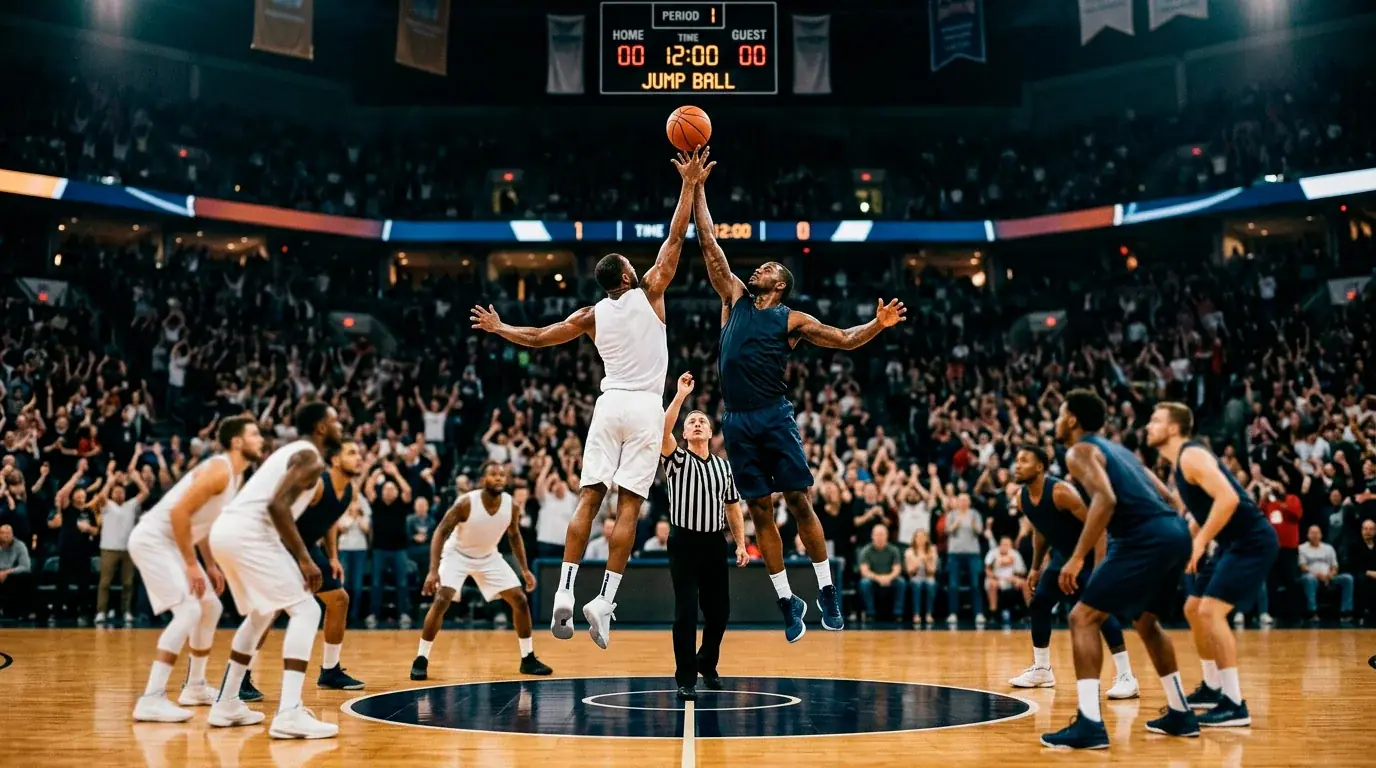
For most of my career, I treated the opening tipoff the way every UK bettor I knew treated it: as a coin flip, decorative, the thing that happens before the actual game starts. Then in 2024 a faculty pair at Dickinson College in Pennsylvania ran a regression on roughly thirteen million NBA play-by-play events and produced numbers that quietly rewrote the way I price every first basket ticket I take.
The headline finding is that teams winning the opening tipoff scored the first basket of the game 64% of the time. Sixty-four percent. That is not a coin flip. That is a meaningful, statistically significant edge that sits in plain sight at the start of every NBA broadcast and that almost no UK bettor builds into a forecast.
This article is the longest version of that finding I have ever written. I want to walk you through where the 64% comes from, why it survives as a real signal once you control for height and home court and team quality, how it breaks down team-by-team, and — most importantly — how to translate it into a price you would actually take on a UK book. Along the way I will be honest about the limits. The tipoff edge is real. It is also smaller than the variance of the bet itself, and that asymmetry is the difference between a profitable framework and a profitable night.
The thread running through the whole piece is one I want you to hold onto: tipoff data is necessary but not sufficient. It is a multiplier on first-shot usage, on team-level first-basket conversion, and on the matchup-specific factors that nobody at a UK book has time to model in real time. That is where the value lives.
To fully capitalize on tipoff data, bettors must understand how to calculate the implied probability for first basket odds before placing their wagers.
- Dickinson College Study Analysis: Verifying 13M Possession Plays Data
- The 64 Percent Rule and Why It Matters
- Team-by-Team Tipoff Divergence
- The Centre as the Tipoff X-Factor
- From Tipoff to First Shot: The Pipeline
- Applying the Data to First Basket Props
- The Limits of the Tipoff Edge
- Frequently Asked Questions
- Where the Numbers Stop Being Numbers
Dickinson College Study Analysis: Verifying 13M Possession Plays Data
The first time I read the Dickinson paper I was sceptical, and I want to walk you through the same scepticism because it is the right way to engage with the numbers. Two researchers — Bilen on the faculty side, Scheiner as the student lead — set out to test whether tipoffs were genuinely meaningful or whether they were, in Scheiner’s own framing, just the same as a coin flip. Their data was the play-by-play record covering roughly thirteen million events.
The methodological move I respect most is what they did to control for confounds. Tipoffs are not random. Taller teams win more of them. Home teams in some smaller arenas win more of them. Better teams generally have better centres, who win more of them. If you just looked at “team that won the tip” versus “team that scored the first basket,” you would conflate the tipoff effect with all of those other things. The Dickinson regression strips that out — controlling for player and team-level factors so the estimated coefficient on the tipoff itself is what you actually want.
The two key outputs from the regression are the ones I want you to memorise. The first is that teams winning the opening tipoff scored the first basket of the game 64% of the time. The second, more subtle, is that teams winning the tipoff finished with a 52.8% game win rate, which translates to a 5.6 percentage-point higher win probability than a random outcome. Both numbers reach statistical significance — meaning they are unlikely to be accidents of small samples.
Bilen’s framing was honest and worth quoting at face value: yes, the weight of a single chance event at the start of the game is small compared to everything else that happens throughout, but the regression is capturing more than just the tipoff itself. The tipoff acts as a proxy for a cluster of things — opening possession, first scoring opportunity, first script the offence runs — and those things compound through the first ninety seconds. The 64% for first basket is much larger than the 5.6 percentage-point effect on the full game outcome because the first basket is the closest decision to the tipoff in causal time.
What this means for a UK first basket bettor is concrete. If you do nothing else with this paper, the one input you should add to every forecast is the team-level tipoff win rate. The price your UK book offers on a player will not have fully baked it in. The book is pricing the player’s general scoring rate, the team’s general first-basket rate, and a small adjustment for matchup. The tipoff variable — multiplied through to who gets the first shot — is where the model on your end can outperform the model on theirs.
The 64 Percent Rule and Why It Matters
Imagine for a moment that you are a UK book pricing the first basket market. Your overround target is somewhere around eight to twelve percent. You need the implied probabilities of all your priced players plus the field option to add up to roughly 110%. The constraint that does most of the work in your pricing is therefore not “what is each player’s true probability” but “what shape of price-set keeps the book within the overround budget.”
Once you understand that, you understand why the 64% rule has commercial weight. The book has priced every player on the floor. The book has not, in most cases, priced the joint probability that this team wins the tip and that this player gets the first shot conditional on the team winning the tip. The team-level probability is implicitly distributed across all the team’s starters in the price-set, and the gap between “starter A on a 60% tip-win team” and “starter A on a 40% tip-win team” is bigger than the book’s pricing model captures.
That is the source of the edge. The 64% becomes useful when you multiply it by tip-win probability for the specific team and by first-shot usage for the specific player. League-average team turnover percentage in the 2024-25 season was 12.6%, which means once a team wins the tip, they almost always attempt the first shot themselves — possession rarely flips before the first attempt. So the chain “tip → first attempt by the winning team → conversion” is tight, and 64% is the empirical conversion rate at the end of that chain.
The number that matters more than 64% in a forecasting workflow is the gap between 64% and 50%. A coin-flip team — say one that wins the tip 50% of the time — gives you a 50% × 64% = 32% probability that the first basket will come from that team’s roster, before you allocate among players. That is meaningful even before any player-specific adjustment. It is the structural reason the strongest first basket bets I take are concentrated on teams with extreme tipoff skews, which I will get to next.
Team-by-Team Tipoff Divergence
Pull up the 2024-25 season tipoff splits and the gap between the best and worst teams will make you sit up. The Lakers won 61.3% of their opening tipoffs that year. The Brooklyn Nets won 36.5%. That is a 24.8 percentage-point gap between two teams playing in the same league with the same ball, the same arc and the same referees. Some teams win the tip over 60% of the time. Others sit closer to 40%. The 20 percentage-point swing is the difference between a starter being a real first basket candidate and being almost an afterthought.
Why does the gap exist at all? Three reasons, in order of weight. Centre rotation is the biggest — a team with a 7’1″ centre with explosive vertical and decent timing wins many more tips than a team starting a 6’9″ power forward at the five spot. The second reason is technique. Tipoffs are won at the elbow, not the hand — the centre who times the rise and tips the ball backward to a guard placed at a specific spot in the circle wins more often than the centre who tries to jump highest. The third reason, smaller but real, is opponent-side selection. Some teams scout where to position the surrounding four players to receive the tip, and some do not.
The practical consequence is that team tipoff splits are sticky across a season. Which means you can use last season’s data and current-season-to-date to forecast tonight’s tip outcome with reasonable confidence. The Lakers’ 61.3% from 2024-25 is a good prior for their 2025-26 number unless their starting centre has changed. Brooklyn’s 36.5% similarly persists unless they have signed somebody who changes the maths.
What I do, and what I would suggest you build into your routine, is keep a tipoff-win-rate column in a small spreadsheet next to each team. Update it every five to ten games. The number does not move much in a small sample, so the maintenance burden is low, but having it visible at decision time is the difference between guessing and forecasting. When I see a UK book pricing a Lakers starter at the same implied probability as the equivalent Brooklyn starter on the same matchup, I know which side of that pairing has the edge.
The team-level number multiplies through to the rest of the chain. If your forecast for whether team A wins the tip is 0.61, and your forecast for whether the team that wins the tip scores first is 0.64, then your forecast for “team A scores the first basket” is 0.61 × 0.64 = 0.39. Plus the residual probability — the team A score given they lost the tip — which works out to roughly 0.39 × 0.36 ≈ 0.14. Total team A first-basket probability: about 53%. Now you allocate that 53% across team A’s roster by first-shot usage, and you have a forecast for individual players that you can compare against priced lines.
The Centre as the Tipoff X-Factor
I once watched the Spurs play three consecutive games where Wembanyama jumped the tip and won every single one. By the third game, the opposing centre was visibly trying to disguise his approach to the circle and Wembanyama was reading it anyway. The tipoff is the most under-analysed phase of NBA basketball precisely because it looks decorative. It is not.
The variables that determine who wins a jump ball are surprisingly few. Standing reach is the most important — taller arm length wins. Vertical leap matters less than people think because both centres jump from a standing start with little run-up. Timing matters enormously. A centre who reads the referee’s release and rises a fraction of a second earlier than the opponent gains an effective height advantage even if the raw measurements are even.
What I have learned to track at the start of every season is centre changes. When a team shuffles its starting five and the new centre at the five spot is shorter or less practised at jumping, the team’s tipoff win rate drops within a handful of games. Those are the windows where I have caught the most value, because UK book prices are slow to adjust. A book holding a Lakers starter at the price they had a month ago, after the Lakers have shifted to a smaller five, is offering a worse implied probability than the new reality justifies.
The other thing centres bring is consistency across the rest of the opening possession. Centres who win the tip cleanly tip the ball to a specific guard at a specific spot, and that guard then runs a specific play call. Centres who win messily tip the ball into a contested zone, and the opening possession becomes a scramble. Both win the tip statistically, but only the clean win produces the disciplined first-shot script that the 64% rule relies on. When I scout opening possessions across a season, I am watching for which centres produce clean tip-and-set plays versus chaotic possessions.
One question UK readers ask me a lot: can centres be substituted just for the tipoff and then come off? Theoretically yes, and the rules permit it, but practically no team does this regularly because the centre then has to sit through a stoppage to come back, which is awkward in NBA flow. So the centre who jumps the tip is, almost always, the centre who plays the first shift. That makes scouting easier — the data you need is the announced starting five, full stop.
From Tipoff to First Shot: The Pipeline
Tipoff won is not first basket scored. There are three more steps in the pipeline, and each one introduces variance and information you can use. The team that wins the tip has to walk the ball up the floor without turning it over, run the play call cleanly, and produce a shot from a specific player. Each of those nodes is its own probability.
The walk-up survives almost every time. League-average team turnover percentage of 12.6% is across full possessions, not just the opening one — and the opening possession in particular sees fewer turnovers because both teams are still settling in defensively and pressure is rare. So the conditional probability “team that wins the tip attempts the first shot” is closer to 90% than to 88%. The pipeline does not leak much there.
The shot itself is where allocation matters. Every NBA team has a primary first-shot taker — the player whose hands the ball is supposed to find on the opening play call. For the Spurs, in their playoff preview last spring, that was Wembanyama, who took 27.6% of his team’s first shots across his 58 starts and posted a 20.7% first-basket rate while the team won the opening tip 77.0% of the time. Those three numbers — usage of the first shot, conversion rate on it, and team tip-win rate — are the building blocks of any individual player forecast.
For Brunson on the Knicks, the equivalent numbers were 23.8% first-shot usage, 21.2% first-basket rate, with the Knicks winning the tip 53.4% of the time and converting to a 61.4% team first-basket rate on those wins. The mathematics is straightforward. Multiply tip-win probability by first-basket-conversion-on-tip-win to get the team’s first basket rate. Then weight by player usage to get the player’s first basket probability conditional on the team scoring first. Add the residual case where the team loses the tip but scores first anyway, and you have your forecast.
Anthony Edwards of the Timberwolves, Jamal Murray of the Nuggets and Neemias Queta of the Celtics tied for the 2025-26 regular-season lead with 15 first baskets each. The interesting thing about that trio is that they got there through different pipelines. Edwards is a high-usage perimeter creator on a team with mid-range tipoff numbers. Murray is the secondary creator on a team that often does not run him as the first option but where his timing on the opening play is sharp. Queta is a centre on a team that wins many tips and runs a tip-to-centre script. Same outcome, different routes — and that distinction matters when you are trying to forecast the next player on the same path.
If you want to dig deeper into the maths, the dedicated piece on calculating first basket percent for prop bets walks through the formula end-to-end with worked examples for several rotations. What I am doing here is a higher-level overview — what to look for, why the components matter — without the spreadsheet detail.
Applying the Data to First Basket Props
Here is the framework I actually use, written out as plainly as I can. For every first basket play I am considering, I want three numbers: tipoff win rate for my player’s team, first-shot usage for my player, and a baseline first-basket conversion rate for that player based on their season-to-date number. Those three numbers feed a single calculation that produces my forecast probability, which I compare against the implied probability of the priced line.
Worked example. Say I am looking at a starter on a team that wins the opening tip at 55%. My player takes 24% of the team’s first shots. The team’s overall first-basket rate when they win the tip is 60%. My forecast for “this player scores first” decomposes as follows: probability the team wins the tip times conversion rate on a tip win times the player’s share of first shots, plus a small residual for tip losses that still produce a first basket. That works out to (0.55 × 0.60 × 0.24) + (0.45 × 0.20 × 0.24) ≈ 0.10. Roughly ten percent.
If the priced line is 7.00 decimal — about 14.3% implied — the book is offering me 14.3% on something I forecast at 10%. That is negative expected value and I pass. If the same player is priced at 12.00 decimal — 8.3% implied — the book is offering me 8.3% on something I forecast at 10%. That is positive expected value and I take it. The framework does not tell me which lines to bet. It tells me which lines have a gap in my favour.
The honest part of the framework is the residual term. If your player’s team loses the tip, they can still score first — through a defensive stop and rapid transition, through forcing an early turnover, through any number of low-probability sequences. The residual sits at roughly 36% of full first-basket scoring across the league, because tip-losing teams collectively still score first about a third of the time. You allocate that residual across the players on the tip-losing team in proportion to their first-shot usage, and you have a complete picture.
The number I would warn UK readers about is overconfidence in any single component. If your tipoff-win-rate input is off by five percentage points — easy to be off in a small sample — your forecast probability moves by a percentage point or two. That is enough to flip a positive-EV ticket into a negative-EV ticket. I rarely commit to a position on tipoff data alone. I commit when tipoff data, first-shot usage and player conversion rate all point the same direction at a price the book has left wide.
The second warning is about playing the same player every night. Even Edwards, Murray and Queta — the three regular-season leaders — converted on 15 first baskets across their respective seasons. That is roughly one every five or six games. Persistent winners over the season, but not guaranteed winners on any given night. Anchor your forecast in the season-level conversion rate, not in the last three games’ results.
The Limits of the Tipoff Edge
I want to spend a moment on what tipoff data does not do, because the limits matter more than the upside. The 64% rule applies to the opening tipoff and only the opening tipoff. Once the game enters quarters two, three and four, the alternating-possession arrow takes over from the jump ball at every dead ball. The arrow is purely procedural — it has no skill component and no signal value for second-half first basket markets.
That makes the second-half first basket market a different bet entirely. The variance is similar but the inputs are not. You cannot use the 64% rule to forecast a Q3 first basket. You have to model the Q3 opening play call instead, which depends on which team has the arrow, which lineup each team has on the floor coming out of the half-time break, and what the score state is. The pricing on second-half first basket markets reflects all of that complexity.
The other limit is sample size. Tipoff data is stable across hundreds of games, but a UK bettor watching tipoff outcomes for two weeks of a season is looking at maybe twenty observations per team. Those twenty observations carry meaningful sampling noise. If the Lakers have won 14 of 20 tips so far, that is a 70% sample but the true rate is probably closer to last season’s 61.3%. Pulling toward the longer-term mean is a discipline I impose on every input I track.
And finally, a word on the variance of the bet itself. Even when every component of your forecast points the right way and the priced line offers genuine positive expected value, the typical first basket position hits less than one in five times. The OddsIndex editorial team put the same point in language that I cannot improve on: first basket ranks among the highest-variance props in basketball, the margins are razor-thin, but margins matter less when you have a 20%+ historical rate, home-court or tip advantage, and odds that undervalue both. That sentence is the whole article in one breath.
Frequently Asked Questions
How accurate is tipoff data when the sample size is just one season?
Single-season tipoff data is directionally useful but noisy. A team that wins the tip 14 of 20 times early in a year is showing a 70% rate, but the true rate after eighty games is more likely to settle around 60% if the centre rotation is unchanged. I treat early-season splits with a healthy dose of regression toward the prior season’s number. Once a team has played thirty games with a stable starting five, the season-to-date number becomes a reasonable forecast input.
Does tipoff really matter for the total game outcome or only the first basket?
Both, but to very different degrees. The Dickinson regression found teams that win the tip finish with a 52.8% game win rate, which is a 5.6 percentage-point edge over a coin flip. That is small. The 64% first-basket conversion is larger because the first basket is the closest decision in causal time to the tipoff. For full-game betting, the tipoff signal is too small to act on independently. For first basket props, it is the central input.
Where can a UK bettor find current-season tipoff splits?
The data is not gathered into a single UK-friendly source, which is part of why I keep my own spreadsheet. NBA Stats publishes opening-quarter possession data that you can derive tipoff splits from. Several US-focused stats sites publish current-season tipoff win rates by team, and you can pull them weekly. The maintenance burden is small once you have a tracker set up — perhaps fifteen minutes a week to update twenty-five teams worth of numbers.
Can centres be substituted just for the tipoff?
The rules permit it, but the practical answer is almost no. A centre subbed in just for the tip would have to come back off the floor at the next stoppage, which disrupts the team’s defensive set on the opening possession. Coaches do not generally do this. The centre who jumps the tip is, almost always, the centre who plays the first shift. So the announced starting five is a reliable forecast for who is jumping.
Where the Numbers Stop Being Numbers
The reason tipoff statistics matter is not that they tell you who is going to score the first basket. They tell you the shape of the probability distribution before any other information arrives. The 64% conversion rate is a structural fact about the NBA — once a team controls the opening possession, the rules of basketball strongly favour them scoring before the opponent does. That is not insight. That is just how the game works.
For more advanced strategies and daily insights, visit the leading NBA first basket betting guide in the UK.
The insight is that UK book pricing does not fully reflect the gap between a 60% tip-win team and a 40% tip-win team, because the book is pricing each player against the field rather than each team against the other. That is the structural inefficiency that gives a careful UK bettor an edge. You are not outsmarting the book on player evaluation. You are using a team-level variable that the book has compressed into the per-player price-set.
If you take only one thing from this article, take this: keep a tipoff-win-rate column in your tracker, update it every two weeks, and apply it to every first basket forecast you make. That single discipline will move your hit rate by a percentage point or two over a season, and at the prices UK books offer on first basket markets, a percentage point or two is the difference between break-even and profitable. The numbers stop being numbers when you start using them.
Written by the editors at nba First Basket Bets.