Same-Game Accumulator with First Basket: A UK Bettor’s Risk Calculator
 Available in US
- Why the SGA Slip Looks So Tempting and Costs So Much
- How UK Books Build SGA Prices Behind the Scenes
- First Basket as an Anchor Leg: When It Helps Your Build
- Correlation Effects: What the Maths Actually Does to Your Edge
- Examples of Good and Bad SGA Builds with First Basket
- Bankroll Discipline When SGAs Become a Habit
- Reading the SGA Slip Like a Trading Desk Would
Why the SGA Slip Looks So Tempting and Costs So Much
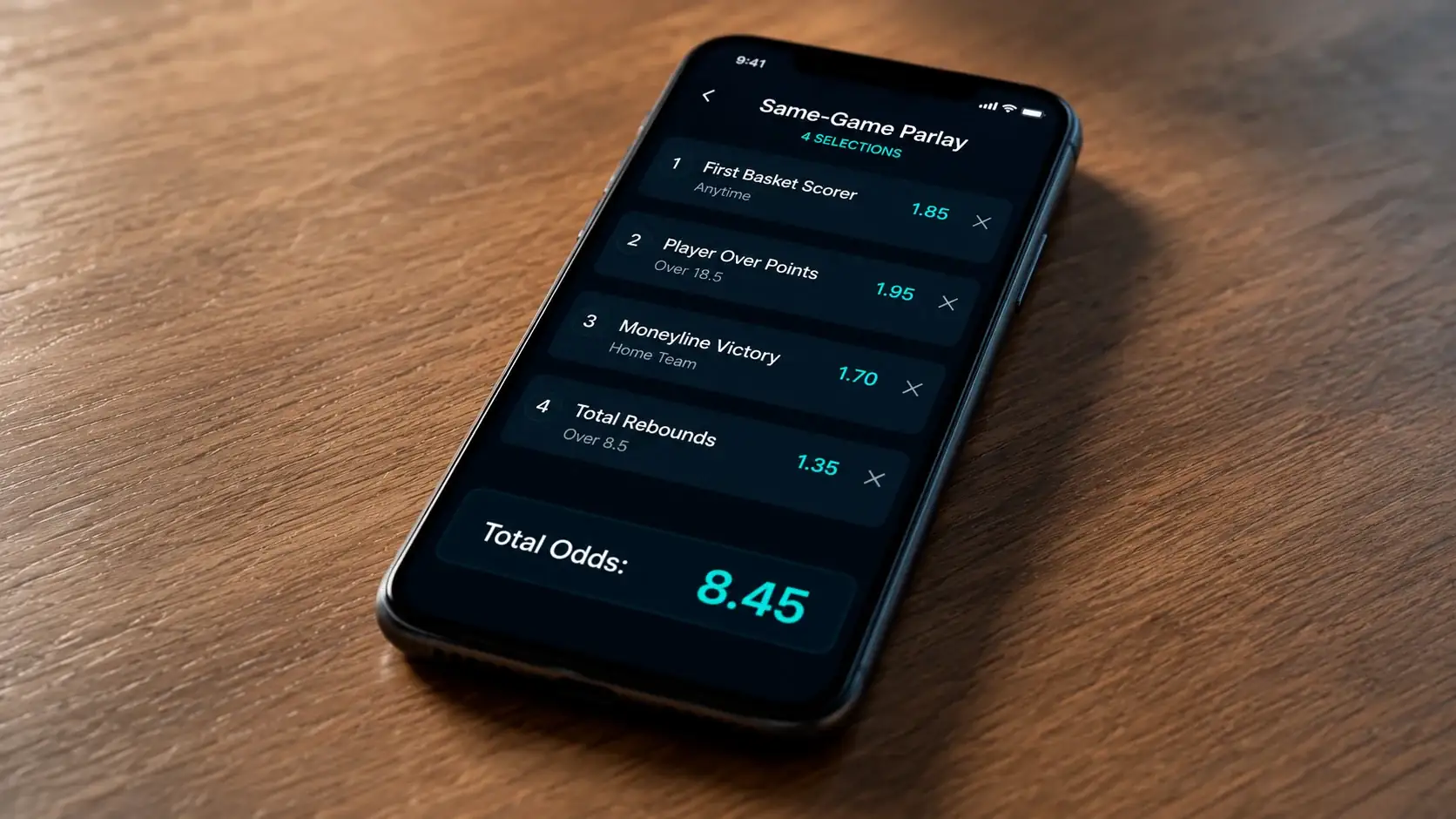
A mate of mine in Croydon talks me through his Friday slip every week. Last December he showed me a Lakers SGA: LeBron first basket, LeBron over 24.5 points, Lakers to win, Davis over 8.5 rebounds. Four legs, decimal price 11.50. He stared at it like it was a small fortune. I asked him what the legs would price as straight singles multiplied together. We worked it out at the kitchen table – naive multiplication came in around 16.40. The book had quoted him 11.50 because the legs were correlated. He had lost roughly 30 percent of fair value before tipoff and did not know it.
That is the entire story of same-game accumulators with a first basket leg. UK bookmakers offer them on every NBA fixture because they sell. Punters love the dream of stacking a star scorer’s opening bucket with his points line, his team’s win, a teammate’s rebounding number. The slip looks like a one-screen narrative – your guy is going to dominate from the opening tip onward. The book knows this, and prices the correlation in. You are not buying a parlay; you are buying a curated outcome story, and the curator takes a tax.
This guide walks through the mechanics: how UK books build SGA prices, why first basket works as an anchor leg in some builds and tanks the equity in others, what correlation actually does to your expected return, and where the discipline lines have to sit if you keep playing these slips.
How UK Books Build SGA Prices Behind the Scenes
Pull up any SGA builder on a UK app and you will notice something. The price moves the moment you add a second leg from the same player. It does not multiply cleanly. Add a third correlated leg and you might see the implied probability tighten by another five or six points. That is the trading desk’s correlation model adjusting in real time, and it is the single most important thing to understand about these products.
The basic engine works in two stages. Stage one prices each leg as if it were independent – first basket at, say, 6.50 decimal, points line at 1.85, win at 2.10. Multiply them and you get a theoretical fair price around 25.25. Stage two layers a correlation matrix on top. The desk has historical data on which props move together. Star players who hit their first basket also tend to clear their points line at a higher rate, because the same conditions – winning the tip, getting an early designed look, the team feeding them – drive both outcomes. The price you see is the independent price multiplied through that correlation adjustment, plus the book’s overround.
UK operators differ in how aggressive their correlation adjustments are. Some apply heavy haircuts the moment you stack two same-player legs. Others let you build looser combos at closer-to-naive prices but cap the maximum number of legs or restrict which markets can co-exist. The result is the same: by the time you tap “place bet,” you are paying for a model you cannot see and cannot interrogate.
The UK regulated market is the largest of its kind in the world. Andrew Rhodes, chief executive of the Gambling Commission, told the Westminster Media Forum that “Great Britain is home to the largest regulated online gambling market in the world, with a gross value now north of £15 billion, with some 22.5 million adults engaging on a regular basis.” That scale matters here because SGA products are some of the most heavily marketed slips on every UK app, optimised by trading desks who have priced billions of pounds of similar combinations and refined their correlation curves to a level individual punters cannot replicate by eye.
First Basket as an Anchor Leg: When It Helps Your Build
Here is something I noticed after watching hundreds of SGA tickets cash and bust over a couple of seasons: first basket is unusually good as an anchor leg, but only in specific build types. It is not a universal upgrade. The structural reason is that first basket resolves in the opening minute. You either win that leg or you do not, and within roughly sixty seconds your slip’s variance has collapsed dramatically. You are no longer praying for four 48-minute outcomes; you are praying for three.
The good builds use first basket as a value-bumping leg attached to legs you genuinely fancy on their own merits. If I like a team to win and the centre to clear his rebounding number, adding the centre’s first basket at, say, 9.50 decimal does two things. It bumps the slip price meaningfully. It also resolves my “did I get the right read” question almost immediately – if the centre wins the tip and the team scores through him, I know within ninety seconds that my read on team flow was directionally correct, even if the bet busts later for unrelated reasons.
The bad builds use first basket as the value-chasing leg that tries to rescue an otherwise dull slip. If you have stacked a moneyline and a spread that the market already prices tightly, throwing first basket on the bench player at 18.00 decimal because “we need the price up” is just compounding tax on top of variance. You are taking a low-probability event with thin information edge and using it to make a slip’s poster price look prettier. The book loves you for it. Trading desks talk among themselves about “price-up legs” – the legs punters add purely to lift the decimal number into double digits, and which on average bleed equity faster than any other component.
The discipline rule I run for myself: first basket goes on the slip only if I would consider that bet as a single. If I do not have a real read on tipoff direction, opening play tendency or first-shot share, the leg is decoration, not edge.
Correlation Effects: What the Maths Actually Does to Your Edge
Correlation in SGAs cuts both ways. Most coverage online treats it as a one-direction problem – the book takes value, you lose. The truth is messier, because it occasionally creates spots where SGA pricing is loose, not tight.
Positive correlation means the events move together. Star scorer hits first basket, he is more likely to clear his points line. Team wins, the spread cover becomes more probable. Stack positively correlated legs and naive multiplication overstates the joint probability – so the fair price is shorter than naive maths suggests, and the book is right to haircut it.
Negative correlation cuts the other way. Player A first basket and player B first basket on the same team are mutually exclusive. If a UK book lets you stack two same-team first basket legs, the joint probability is zero. Most UK builders block that combo automatically. Some do not, and a slip with logically impossible legs sits there waiting for you to fund it.
The interesting middle case is independent or weakly correlated legs. Player first basket and total points over are close to independent – the opener has marginal information value about a 220-point total. Here the SGA price should approximate naive multiplication minus the overround. If the book applies an aggressive correlation haircut to a combo that is genuinely independent, the punter is being penalised for correlation that does not exist. These are the rare spots where SGA pricing goes loose, particularly on builds that mix opening-action props with full-game team totals.
The practical takeaway is hard but simple. Either you understand which legs are positively correlated, negatively correlated or independent, or you are guessing.
Examples of Good and Bad SGA Builds with First Basket
Walk through three builds with me. None of these are recommendations. They are illustrations of structure.
Build one. Spurs versus a tipoff-weak opponent. Wembanyama first basket at 4.80 decimal, Spurs to win at 1.65, total game points over 222.5 at 1.90. Across 58 starts in the relevant sample window, Wembanyama posted a 20.7 percent first-basket rate, the Spurs won the opening tip 77.0 percent of the time, and Wembanyama took 27.6 percent of his team’s first shots. The first basket leg is anchored to a structurally favourable tipoff edge and a high first-shot share – it is not a guess. The win leg is moderately positive correlation; the total is weakly correlated. The book will haircut perhaps 15 percent off naive multiplication. This is a coherent slip.
Build two. Same game, but the punter swaps Wembanyama first basket for the bench scorer’s first basket at 28.00 decimal because the price-up looks delicious. The bench scorer has no role in opening play, no tipoff stake, no first-shot share. The book is not heavily correlation-haircutting because the leg has nothing meaningful to correlate with. But the punter is now buying a near-zero-edge lottery ticket as the slip’s spine. The slip price looks better; the expected value is shredded. This is the price-up trap.
Build three. Two same-team first basket legs in one slip. Player A first basket and Player B first basket. A well-built UK SGA tool will block this. A poorly-built one will let you submit it, and the slip cannot resolve as a winner because the events are mutually exclusive. If you find yourself constructing this combination, you are no longer betting; you are donating, and the cause is the operator’s hold.
The pattern across all three: the first basket leg is only worth its slot if the player’s tipoff context, first-shot share and offensive role lift the implied probability above the offered price. Without that, you are decorating a slip rather than building edge.
Bankroll Discipline When SGAs Become a Habit
I will say this plainly. SGAs with first basket legs are the highest-variance products on a UK app shy of futures. Treat them like cash equities and you will go broke quickly. The bankroll discipline that works for first basket singles needs to tighten further when the bet form is multi-leg.
The UK sports betting market generates around £2.48 billion in annual GGY as of early 2026, and a meaningful slice of that runs through SGA-style multi-leg products. The hold on multi-leg slips is structurally higher than on singles – every leg you add multiplies the book’s effective margin into your expected return. A single with 4 percent house edge becomes a four-leg slip with effective edge in the low double digits. You need a serious skill differential to overcome that, and “I quite fancy these four things” is not it.
The unit-sizing rule I use for SGAs is half the unit. If my standard first basket single is one unit at 1 percent of bankroll, my SGA stake is half a unit at 0.5 percent. Additional variance and additional book hold both push the same direction; unit size is the lever I have to compensate. The cap on monthly SGA spend sits at a hard 20 percent of my prop bankroll, and when I hit it, I stop. No exceptions for big TV games.
The other discipline lever is record keeping. Track SGAs separately from singles. Their ROI distribution is wider, the sample needed before you can claim edge is larger, and you will fool yourself for months if you fold them into single-bet performance. The numbers usually tell a tidy story when separated, and the story is rarely flattering.
If the maths and variance discussion above resonate, the deeper read on managing in-game opportunities is in my piece on in-play first basket strategy, where the same correlation logic applies but with shorter time horizons.
Reading the SGA Slip Like a Trading Desk Would
The closing skill is reading your own slip the way the desk reads it. Ask, before you tap place: which of these legs are positively correlated, which are negatively correlated, which are independent? Where on this slip is the price-up leg I added because the decimal number looked nice? What is the realistic joint probability of all four legs hitting, and is the offered price actually compensating me for that joint probability or punishing me for taking the bait?
If you cannot answer those four questions in under thirty seconds, the slip is built on hope. There is nothing wrong with hope as a Friday-night entertainment product, provided your stake reflects that. There is something wrong with hope masquerading as edge – and that is what UK bookmakers sell, very profitably, every NBA night of the season.
Are SGA combos rigged?
No. They are correlation-priced, which is different. UK books apply correlation models that adjust the joint price away from naive multiplication. The slip is mathematically priced against you, not rigged in any procedural sense, and the maths is the same maths the trading desk uses internally.
What legs correlate with first basket?
Same-player points line, same-player rebounding for centres who win tips, team winning margin in close games, and team total points to a weaker degree. Negatively correlated: any other player on the same team to score first. Independent: most full-game props for unrelated players.
Created by the ”nba First Basket Bets” editorial team.