Second Half First Basket Betting: A Forgotten UK Market
 Available in US
The market my Brighton-based mate forgot existed
A friend of mine has been betting NBA props on bet365 for five years and never once placed a second-half first basket bet. He didn’t know it existed as a separate product. He assumed first basket meant first basket of the entire game, full stop. I introduced him to the second-half market last spring and he tripled his prop volume on it inside a month, because the pricing inefficiency on the second-half line is even larger than on the standard first basket. The market is forgotten. The math is not.
Second-half first basket is exactly what it sounds like – a separate prop market that settles on the first made field goal after halftime. It is a fundamentally different proposition from the standard first basket because the opening possession after halftime is not determined by a tipoff. It is determined by the alternating-possession arrow, which means the team that lost the opening tipoff at the start of the game gets the ball to start the third quarter. That single rule difference reshuffles the entire mechanic of the market.
What I want to walk through here is how the second-half market resets after the halftime break, the alternating-possession arrow rule and how it works, why the rule matters for pricing, the “first 3 minutes” dashboard concept I use to model second-half first baskets, and which UK operators offer the market. By the end you should know whether the second-half market is something you want in your prop rotation – and how to price it if so.
How the second-half market resets
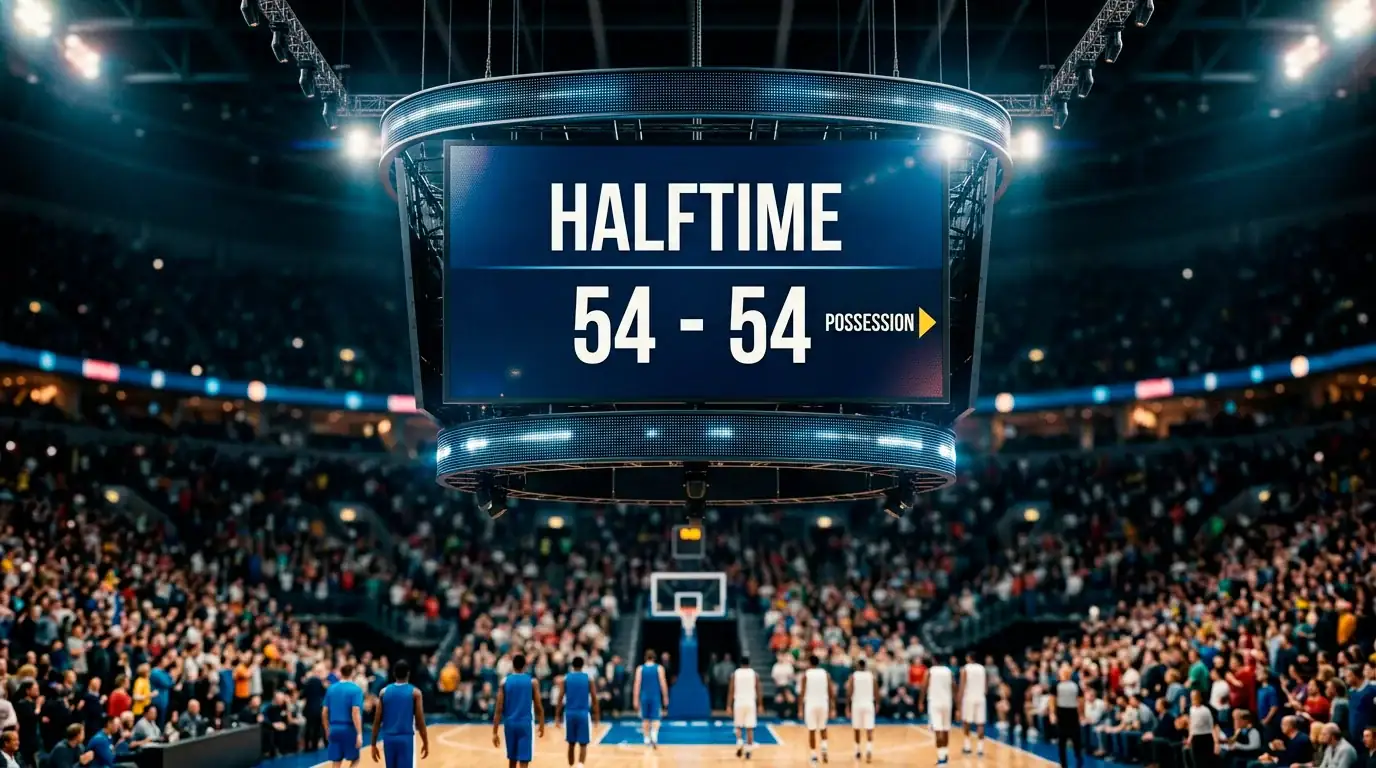
At halftime, the standard first basket market has long since settled. Whoever scored the first field goal of the game in the first quarter took the bet. The second-half first basket is a fresh contract opening at halftime, with a fresh set of odds, on a fresh question – who will score the first field goal of the third quarter?
UK books that offer the market typically price it during halftime, with prices going live as the third quarter approaches. Some operators offer the market in pre-game form alongside the standard first basket – letting you bet the whole package before the game starts – but more often the second-half line is a halftime-only product, which makes it functionally an in-play market.
The pricing reset matters because the players who score the first basket of the third quarter are not the same group as the players who score the first basket of the first quarter. Halftime adjustments change rotations, fatigue starts to factor in, and the team whose script was working in the first quarter may have a different script for the third. This is one of the structural reasons the second-half market is harder to model – and where the inefficiency lives.
The alternating-possession arrow rule
The alternating-possession arrow is the NBA’s mechanism for handling jump-ball situations during the game without an actual jump. After every held-ball or other arrow situation, the ball alternates between teams based on whoever last held the arrow. The second-half kick-off is treated as an alternating-possession situation: the team that lost the opening tipoff at the start of the game receives the ball to start the third quarter.
This is an enormously important rule for the second-half first basket market because it inverts the team-by-team probabilities. The team that lost the opening tipoff – whose first basket conversion rate was lower than 50% in the first quarter because they did not have possession – now has the ball to start the third quarter. So the team that was the underdog on the standard first basket market is the favourite on the second-half market, all else equal.
Scheiner, one of the Dickinson College tipoff researchers, framed the broader question this way: “in hindsight, our research explores whether tipoffs have a statistically significant effect on the outcome of an NBA game or if they are just the same as a coin flip.” The same question applies to the alternating-possession kick-off, but in reverse: how much of the team’s first-quarter advantage carries into the third quarter, and how much is reset by halftime adjustments?
Why the alternating arrow matters for pricing
The pricing implication of the alternating arrow is direct. If the home team wins the opening tipoff, the visitors get the ball to start the third quarter – and the second-half first basket market should reflect that visitor possession advantage. UK operators frequently fail to account for this with sufficient weight; their second-half first basket prices on the visiting team’s players are often only marginally shorter than the home team’s, even though the possession advantage is identical in magnitude to a tipoff win.
The league-average team turnover percentage in the 2024-25 season was 12.6%, meaning the team with possession converts roughly 87% of opening possessions into a shot attempt. That conversion rate applies equally to second-half opening possessions as to first-quarter opening possessions. So if a team has the alternating-arrow possession to start the third quarter, their probability of taking the first shot of the second half is roughly the same as a team that won an actual tipoff in the first quarter.
The mispricing pattern: UK books that quote second-half first basket markets often build their lines from the standard first basket numbers without inverting the possession layer. The result is that visiting-team players are systematically underpriced on the second-half market when their team has the alternating-arrow possession, and home-team players are systematically overpriced on the same nights.
The first three minutes dashboard concept
The methodology I use for second-half first basket pricing leans on what I call the “first three minutes dashboard” – a pre-built reference for each team showing their typical post-halftime patterns over the first three minutes of the third quarter. Three columns: who tends to take the first third-quarter shot, who tends to draw the first foul, and what the first scoring outcome typically is.
Building the dashboard requires the same kind of data work as the standard first basket model. You need a sample of at least 20-30 games per team to get a stable estimate of their first-three-minutes patterns. The data inputs are the play-by-play feed for each game, filtered to the first three minutes of the third quarter, with a row per first-shot event and a row per first-scoring event.
What the dashboard reveals: some teams have second-half scripts that are radically different from their first-quarter scripts. Coaches use halftime to adjust to whatever the defence has shown them, and the third-quarter opening play often features a different first-shot taker than the first-quarter opening. Other teams have nearly identical first-quarter and third-quarter scripts. Knowing which is which is the entire game.
UK availability of the second-half market
Second-half first basket is not available on every UK operator. The UK sports betting market generated approximately £2.48 billion in annual gross gambling yield as of early 2026, and the share of that volume passing through second-half prop markets is small enough that some operators do not bother offering them. Among the four big UK books, bet365 and Paddy Power list the market most consistently; William Hill carries it on showcase fixtures; Sky Bet rarely offers it.
The operator that does offer the market often prices it less aggressively than the standard first basket market – wider vig, less depth in the lineup, sometimes only the top six or seven players priced individually with everyone else lumped into a “field” line. The wider vig is partly because the operator does not have as much trading data to calibrate the line, and partly because the bet volume per fixture is lower, which means the trader cannot afford to be as aggressive on margin.
For a UK bettor, the practical workflow is to identify which of your operators offer the second-half market reliably, check the pricing during halftime, and place the bet only if your model output beats the implied probability by a meaningful margin. In playoff fixtures the second-half market behaviour shifts further because rotations tighten and coaches make more aggressive halftime adjustments – which in turn changes the third-quarter first-shot distribution.
Does every UK sportsbook offer second-half first basket markets?
No. Among the four big UK operators, bet365 and Paddy Power list the market most consistently. William Hill offers it on showcase fixtures, Sky Bet rarely. Smaller UK operators usually do not offer it at all. The bet volume per fixture is too low for some books to justify the trading effort.
How does the alternating-possession arrow affect second-half first basket bets?
The team that lost the opening tipoff in the first quarter starts the third quarter with possession. This inverts the possession advantage from the first quarter – so the underdog on the standard first basket market becomes the favourite on the second-half market, all else equal. UK operators often underweight this when pricing the second-half line.
Written by the editors at nba First Basket Bets.